Acoustic Underlay for LVT – What type of sound insulation can be used.
LVT flooring (luxury vinyl tiles) has become an increasingly popular choice in recent years given the advantages it has over other types of floors. It combines warmth, slip-resistance and quietness compared to laminate and wooden floors, but it is also more durable given its ability to resist water and minimise damage caused by scratches and dents.
Given these advantages, it is no surprise that LVT is a very popular and choice for covering concrete floors. These types of floors are easily enhanced by LVT given how it brings a softness, comfort and sound absorption to balance the cold, hard characteristics of concrete.
However, if you are considering laying LVT onto a concrete floor, you need to think about whether you will need to add a form of acoustic floor, underlay or soundproofing. This could take the form of LVT underlay or a more comprehensive soundproofing concrete floor system to deliver the required floor sound insulation. But which acoustic insulation for concrete floor with LVT is right for your property?
Why LVT Needs an Acoustic Underlay
Although LVT offers more comfort than hard surfaces such as laminate or wood, it can still transmit impact noise through the structure beneath it. This is especially noticeable on concrete floors, where footsteps, furniture movement or dropped items can cause vibrations that travel to rooms below.
The other type of noise that transmits through concrete floors is airborne sound. This is sound generated from activities like people talking, music playing or a TV which travels through floors and walls from one room or property to another.
Can my new LVT provide good soundproofing on a concrete floor?
You might think the high mass or density of concrete is sufficient for this material to block airborne sound, but it can still pass through due to weaknesses in the structure, flanking (sound leaking through weak points like the floor perimeter) or due to the design of the concrete floor itself.

Consider precast concrete hollowcore planks, for example, which have holes running through them – these can help sound transmit. These are the reasons why your project may also need airborne sound insulation to ensure you apply an effective floor soundproofing solution.
If you choose not to insulate under an LVT floor on any type of sub-floor, you risk it feeling hard and the room could seem noisy. That will make the room less comfortable and appealing, and could affect the property’s attractiveness for letting to potential tenants if it is a rental home.
What are the Key Considerations When Choosing Acoustic Insulation for LVT?
First steps to determine what type of soundproofing you need for your concrete floor when laying LVT is to assess the subfloor. This is absolutely key to any flooring acoustic performance.
You also need to consider what level of acoustic performance you want to achieve, particularly if the separating floor must comply to minimum standards set by the Building Regulations, such as Part E in England & Wales. This could, in turn, impact on the overall floor build-up – its thickness (depth) and density. These are key factors in acoustic floors with sound reduction capabilities, but they could also affect the floor stability.
What is important when choosing acoustic insulation for LVT?
You may also want to consider seeking guidance on incorporating a moisture resistance barrier in the form of a membrane if the concrete floor’s location requires one. This will help to ensure the LVT floor finish meets expectations in the long term.
So, incorporating an acoustic treatment including floating floor panels, membranes and battens could be one approach. In other situations, the solution could take the form of an acoustic underlay, including those which are classed as a moisture barrier underlay. Remember that not all types of underlay suit LVT, so it is important to avoid certain types, such as those which are primarily designed for carpets or laminate floors.
As for the best underlay for LVT on concrete – that will depend on a number of factors as you can read below.
Choosing the Best Type of Underlay for Soundproofing LVT Floors
Not all underlays are suitable for luxury vinyl tiles. Carpet or laminate underlays are often too soft and can cause movement in the joints or lifting of the tiles. Instead, look for an acoustic underlay for LVT specifically engineered for thin, dense flooring systems.
Foam Underlays
These are generally lightweight, budget-friendly and readily available, making them an instantly attractive option, particularly if you are looking to keep the cost of acoustic underlay for LVT to a minimum. They are manufactured from materials such as modified XPS (expanded polystyrene).
While they do offer a degree of impact sound reduction, typically in the range of 17-19 dB, this may not make a significant difference because these materials will generally lack the density required for concrete floors.
Rubber Underlays
Choosing a rubber underlay for vinyl flooring could be a wiser option. This is because these materials are relatively dense, making them excellent for impact noise reduction, and they are long lasting as well as being moisture resistant.
However, not all rubber underlay products are the same by any means, with some only offering impact noise reduction at similar levels to some foam underlay products. Choose a specialist rubber underlay such as Hush FFR Resilient Underlay and you can achieve improved sound reduction – 21 dB for the 5mm thickness.
Cork Underlays
Another option for acoustically insulating an LVT floor is cork underlay soundproofing. This is an appealing option where the goal is to use a more eco-friendly and natural composition for providing sound reduction. Cork is effective at reducing both impact sound transmission and airborne noise, but it may not provide a firm enough surface for certain LVT installations.
Specialist LVT Underlays
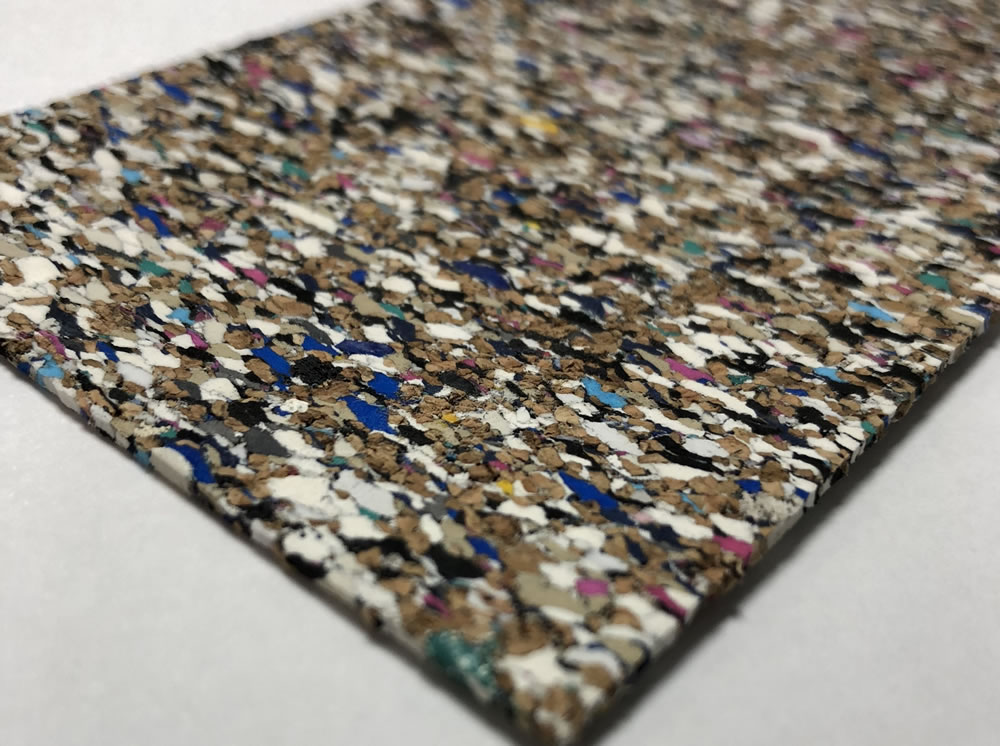
The fourth option is to choose an underlay that has been designed specifically for luxury vinyl tile such as Hush Underlay for LVT Flooring. Such products are designed to combine acoustic insulation and stability, with minimal floor build up.
In the case of the Hush Underlay for LVT Flooring, it also has environmental benefits in that it is composed of recycled materials, and it is designed to remain continually elastic throughout its lifespan.
Can I achieve the Building Regulations sound insulation with underlay on a concrete floor under LVT?
Providing the concrete subfloor is suitable, yes, it is possible to meet the minimum standards set by the Building Regulations relating to sound transmission. However, to meet the standards, an additional treatment may be required to upgrade the performance of the concrete slab to achieve the required decibel reduction levels for multi-residential properties.
In England & Wales, where the Building Regulations apply to a project, the floor will need Part E compliance. That means airborne sound insulation at a minimum of 45 dB (DnT,w + Ctr) for new build dwellings and 43 dB for dwellings created by Material Change of Use (conversions).
Impact sound insulation must be no higher than 62 dB (L’nT,W) for new build and 64 dB for conversions.
Buildings in Scotland are covered by Section 5 of the Technical Standards and in Northern Ireland it is Part G. Both may specify minimum levels which are different to Approved Document E.
Whichever soundproofing approach you choose, ensure the products you select are backed by test data to substantiate the manufacturer’s claims.
When might you need to fit an acoustic floor system under LVT on a concrete floor?
If the goal is to achieve the highest acoustic performance for a concrete floor with an LVT floor finish, creating an acoustically insulating subfloor in the form of an acoustic floor system is a must. However, the desire to reach the highest standards will need to be balanced with other factors such as budget, the floor build up and how this will impact on the room’s floor to ceiling height and how much disruption can be tolerated.
If the existing concrete floor is in a relatively poor condition, such as being uneven, cracked or containing lots of holes or penetrations, the creation of a new subfloor is recommended. This will allow you to install new floating floor panels to create a level and smooth surface onto which you can install a further layer of underlay and the LVT covering.
Which systems can be used to provide acoustic insulation for concrete floor with LVT?
Acoustic systems are valuable because they decouple the floor covering – the LVT tiles – from the floor structure and they provide mass. Both these functions break or disrupt sound waves with the result being that less impact sound passes through the floor and more airborne sound is absorbed and converted into energy.
The type of acoustic system to choose for LVT over concrete will depend on a number of factors. Remember too that to get the best performance out of any acoustic floor system you will to treat both above and below the structure – that means a new subfloor and a suspended/new ceiling. Therefore, if you do not have access to both, the performance possible may be much lower than it could be.
A good system starting point is the Hush HD1007 Hush System HDC. This is a relatively simple concept which makes use of Hush Panel 28 to create a floating floor and battens below to enable a new decoupled ceiling to be installed.
For improved sound reduction performance, a system such as HD1037 Acoustic Batten 55 System MF could be an option. This combines resilient 55mm acoustic battens with a metal frame (MF) suspended ceiling to achieve excellent airborne and impact sound insulation. Key to its performance is the service void it creates within the floor construction, which is filled with absorber slabs, with the trade-off being that it does add more depth to the floor and ceiling overall versus some of the other systems.
What do we recommend for acoustic insulation on concrete floors with LVT?
If you are looking for an entry level of soundproofing for an LVT floor over concrete, you could choose a basic foam or rubber underlay that is available from major DIY stores or through online retailers. However, in many cases we don’t think this will provide a particularly worthwhile acoustic improvement.
Hence why, if you are going down the underlay route without installing an acoustic system, we would recommend looking at our Hush Underlay for LVT Flooring or Hush FFR Resilient Underlay. Both these will offer sound reduction without compromising the stability of the floor surface or adding significant height to the floor level.
For the best results, where budget and the property permits, and in situations where you need to go achieve sound reduction to a level beyond the minimum set by the Building Regulations, we recommend installing an acoustic system. We have several fully tested acoustic systems to choose from which you can view on our Concrete Floor Systems page.